

Öcalan Surpassed Marx Again, and Reached What?
 Socialist
Dec 24, 2025 09:30
1689
Socialist
Dec 24, 2025 09:30
1689
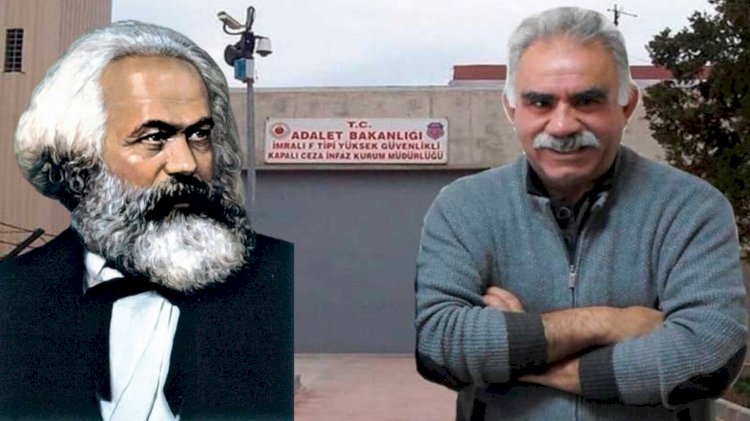
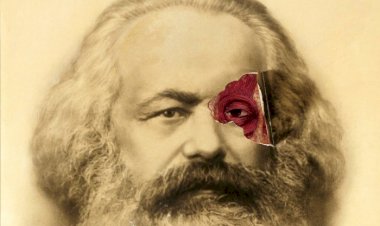
Hasn’t Marx had enough?! To be declared outdated, unable to describe today’s society and still, everyone races between themselves to debunk you… Not only your enemies, but also your political rivals! Nearly a hundred and fifty years have passed since the passing of Marx, yet, the theory and perspective he has put forward are so impactful and powerful that debunking him, surpassing him is a dream of many.
Apparently, Öcalan also, once again, declared in a text written for the “Conference for International Peace and Democratic Society” organized in Istanbul in the past week, that he “surpassed” Marx. In short, he identified the need for separating Marx and Marxism, that Marx was good in will but that his era wasn’t enough to understand today’s capitalism’s issues, that it wasn’t enough to describe capitalism by the concept of class war. Good riddance(!) Although we differ with many of the arguments presented in the text, it is best to argue with the conception that gives the text its character. When you present the ineptness of that conception, the rest falls apart anyways.
Öcalan presented his project as radical democracy in his previous statement. The ones that put this concept in the agenda of the left are Laclau and Mouffe. This pair, internalizing the defeatist psychology of 1970’s global retreat of workers’ movement, dissolution of the Eastern Bloc and capitalism’s declaration of victory; stated that a capitalism internal solution may be put forward to the left with the concept of radical democracy in their 1985 book “Hegemony and Socialist Strategy”. The book rejected the emphasis Marxism made of the determining role of class struggle, instead defending that it was possible to separate liberal ideology from its economic dimension and promote its political side and that the objective of the left, including the in-system radical wing, was to struggle to radicalize democracy:”…not to reject liberal-democratic ideology, on the contrary, to deepen and widen it in the projection of a more radical and pluralist democracy.” So, it was possible to conceptualize liberalism separated from its economical dimension: market economy, capitalist disparities etc. The same logic applies to Öcalan’s latest statement. Let’s give a note before discussing this topic further. Years after, the authors of the radical democracy thesis started to say to the left that instead of this thesis, it was necessary to act under the unity of left populism and to emphasize the people and labor in such unison, just as the power of liberalism was shaking in capitalist metropoles. Mouffe even self-criticized in his book on the topic, saying that they were mistaken to ignore the class dimension.
A Democracy to Win, but How?
It is impossible for us to reject the struggle to deepen democracy. But how are we going to do that? Is a mere political struggle sufficient? How is such a struggle going to emerge?
Open popular support and mass mobilization is necessary for political struggle. In other words, you need masses to win democracy. But the capitalists laid heavy hits on the organization of the people with the program of liberalism’s post-1980 name neoliberalism. In many countries, the organized struggle of the working masses was flattened with tanks. The rest is history. We not only lost on the front of economic rights, democracy and freedoms have also regressed. Late capitalized, contradiction filled countries such as ours are already wrestling with authoritarian regimes. But the situation in Western metropoles are also deteriorating. Trump is reigning terror on the US. The pro-Hitler ideologies are rising in Germany and Scandinavian countries, so-called strongholds of democracy. Today, the power of liberalism has weakened globally, even for the ruling classes.
Why is Class Struggle Still the Determining Factor?
It is not surprising to see that class perspective is off putting to the leaders of the oppressed identities’ movements. “Dividing” the unity under oppression on class lines will surely be detrimental for them. Therefore, it is natural for the perspectives of oppressed identities’ struggle and class struggle to be in tension, this phenomenon has quite the precedent. However, trying to defame Marxism speaking as if a revolutionary, especially after swinging so far right in the leftist political sphere, seems quite rough.
To create a common struggle between the oppressed communities relies on taking a moralist position rather than a materialist one. In order to bring together different communities suffering from varying oppression or not oppressed groups, you need a common goal, an objective. Otherwise, different identities are not direct comrades of each other in spirit and action. Let’s give an example. Say, when the Alevites in Syria were being massacred, the Kurdish National Movement showed little to no response, leading to a great reaction in the Alevite movement. Or when homosexual Kurdish young people attended Newroz (Kurdish spring celebration) in Amed (officially Diyarbakır). Unfortunately, being a member of an oppressed community does not directly equip you with the politically correct positions on other oppressed communities. An oppressed Alevite may become a chauvinist when it comes to the Kurdish question, or vice versa. Or how most oppressed groups single out the Romanis. There are many more examples…
Class issues, on the other hand, provide strong material grounds for mobilizing and uniting large masses for struggle. Even in a singular workplace struggle, if the workers don’t band together against their boss, they are defeated. This, in turn, lays the material foundations for a universal understanding and organization that supersedes identitarian and cultural differences. This is not an automatic process, rather, a tendency created by the material foundation. Therefore, the ruling classes try to break this tendency not just by physical instruments but also ideological ones. It should also be pointed out that the periods in which the workers’ movement rises, the masses swing to the left, the dividing ideas regress and the pressure on the oppressed largely break down. 1917s and the 1968s are great examples of this. The periods in which the ruling classes and their hegemony of their values weaken, it is a celebratory time for the oppressed.
A New Dialectic, A New Recipe for Liberation
Öcalan put forward a new form of dialectics: a new dialectic where opposing forces and their antagonisms are not resolved by negation. In actuality, this no longer has anything to do with dialectics, but alas.
This idea of a new dialectic is not new. Mouffe puts forward an idea of agonisms, instead of antagonisms resolved by contradictions, instead concatenated to one another. Öcalan’s words are in this very framework:
“We have to see contradictions not as extremes that destroy each other, but that feed each other. Because a state without the commune, bourgeoise without the proletariat cannot exist.”
The logical conclusion of this idea is trying to resolve the contradiction between the state and popular struggle without one negating the other, instead, by concatenating the opposing forces.
Is this possible? Say, how can an authoritarian administration that wants to create a one-man regime and people who want to protect their democratic rights come to terms? How are the Turkish capital that wants to exploit workers to poverty and the workers themselves going to concatenate. As long as the system of exploitation continues, how different can the concatenation of the workers to the system be from complete surrender? Finding a middle ground, especially in an era where capitalism creates economic, political and societal crises; is impossible.
Is a Lasting Democracy and Its Struggle Possible Under Capitalism?
Radicalizing democracy by staying with-in capitalism is not a lasting solution. Because capitalism continuously reshapes. Something you gain today may become history tomorrow. The lasting solution is to permanently remove the need to infinitely toil and struggle for democracy.
The fate of democracy under capitalism is shaped by the balances between the classes and periodic crises of the system itself. As this balance and cycle fluctuates, the democratic sphere and the position of powers change. The chief determining factor is the extent of societal hegemony of the ruling class. The ruling class that can provide prosperity doesn’t have qualms with basic level liberal democratic processes. But in later capitalized and with puny capital development countries such as ours (referring to Turkey), the ruling class’s power usually comes from oppression as the prosperity cannot spread among the people. See, we don’t have to refer back to the 1929 depression to see how things change in the Western metropoles when prosperity is shaky. Today as well, clear to everyone, the system in crisis paves the way for the far-right and authoritarianism.
Another determining factor of the limits of democracy is the organized power and action capacity of the working class. This is also not permanent. The energy of the masses fluctuates.
Therefore, capitalism requires all the Nazi gas chambers, the Argentine coup plotters that killed thousands of leftists in the ocean, European style democracies, populist authoritarian figures like Trump… The ruling classes intervene as necessary to pave the way for the system’s continuation. It is not certain which political form will succeed despite the ruling classes wishes. The process takes shape with the intervention of antagonizing classes.
Still, as capitalism exists, the door will always be open for extremist regimes and oppression. And the millions that fight against it will not be besides us most of the time. We see this even in the Kurdish national movement’s history.
Closing Remarks
Duran Kalkan (a former PKK leader), responding to criticisms on Öcalan’s remarks on socialism, said said “Come and take a lesson from us.”. It is apparent that criticisms on Öcalan’s “I surpassed Marxism” statements break some nerves. It is the same case when it comes to the criticisms on Kurdish National Movement’s alliances.
The nature and context of the relationship established with the AKP-MHP ruling bloc, which is virtually butchering democratic rights, is putting the Kurdish National Movement in a difficult position. The Öcalan cult is becoming more important than ever at this point. The socialist movement is being asked not only to support the negotiation process but also to embrace the claim that "Marxism is outdated," and in fact, to deny its own identity.
It is significant that those who belittle the weakness of the socialist movement at every opportunity are so sensitive to criticism, and even disapproval, coming from within the socialist movement itself. This sensitivity is not without reason, because socialists, constantly attacked for "failing to generalize and being weak," possess an influence far greater than their size suggests, due to their leading role in street struggles, their ethical superiority over capitalism, and their role as an ideological/cultural point of reference. Therefore, the question of "why take ineffective left-wing groups seriously?" cannot be posed; instead, an unending effort to include them, or failing that, to condemn them, continues. The situation has reached a point where even the label of "they cannot tolerate a Kurdish leader" is resorted to.
But to put it bluntly, you can't have strong ties to the global imperialist capitalist system and its masters, the US and Israel, while simultaneously making the grand claim that you will be the new worldwide guide to socialism. Indeed, it's not just the Turkish left that sees this contradiction. The widespread sympathy for the Kurdish National Movement and Rojava that existed among the global left until recently has largely dissipated today. This is hardly surprising for the global left, which rightly harbors great hostility towards Israel and the US. In short, defending the equality and freedom of the oppressed Kurdish people against chauvinism is one thing; entering the organizational and ideological orbit of the Kurdish National Movement is quite another. The issue needs to be framed this way.