

Social Apartheid by Design: Law, Religion, and Violence Under Taliban
 Socialist
Feb 9, 2026 08:44
1500
Socialist
Feb 9, 2026 08:44
1500
by Laila Safi
On January 4, 2026, the Taliban issued a Criminal Procedure Code signed by leader Hebatullah Akhunzada. The Code consists of three sections, ten chapters, and 119 articles. Its contents are unique in the modern world. It legalizes slavery, allows torture based on presumed impiety, and permits convictions from “testimony” or “confession” without any right to a lawyer. In complete incompatibility with fundamental principles of human rights, it features practices reminiscent of the Middle Ages.
Not equal before God, not equal before law, just ranked, ruled, and punished. There is a lie perpetuated by tyrants whenever they seize power: that all are equal before God. In Afghanistan today, that lie has once again undermined itself. The Taliban have not merely imposed repression; they have institutionalized hierarchy. They have replaced civil law with a stratified order in which status, obedience, and proximity to power determine one’s value, producing a system akin to caste rule, where entire groups are reduced to legal inferiority, coerced dependence, and conditions resembling modern servitude.
Institutionalized Discrimination and Social Hierarchy
Article 9 divides society into four classes: scholars (ulama), elite (ashraf), middle class, and lower class. Punishment for identical offenses varies based solely on social status: scholars receive advice, elites are summoned and warned, middle-class individuals are imprisoned, and those from the lower class face imprisonment and corporal punishment.
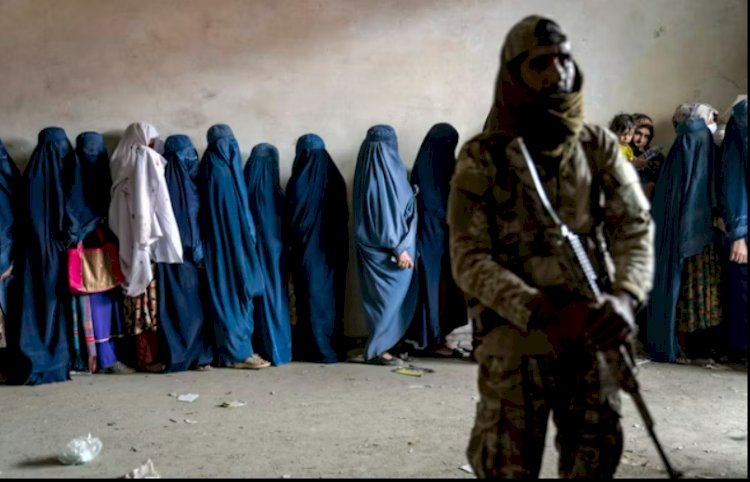
Women are not included in these classes, they are already at the bottom, outside the law, outside society: not citizens, not participants, and not dependents with rights. Their non-classification reinforces the institutionalized erasure of women from society.
The Code explicitly recognizes slavery, referring to individuals as “slaves” (ghulam), authorizing husbands or masters (badaar) to carry out punishments (Articles 4(5) and 15), and formally dividing society into free and enslaved individuals, a status absolutely prohibited under international law.
Clause 11 of Article 2 defines baghi (“rebel”) as someone who “seeks to propagate corruption,” stating: “Their actions are considered to inflict widespread societal harm, and they are regarded as irredeemable, meriting punishment by death.”
This grants the Taliban sweeping authority to target critics, opponents, and human rights activists. The law’s ambiguity ensures arbitrary enforcement, amplified by the group’s notorious brutality.
- Article 4(5): Permits husbands or masters to execute punishment. This legitimizes private violence within households, exposing women and minors to abuse without judicial oversight.
- Article 32: Limits criminal liability to cases where a husband beats his wife with a stick causing serious injury, ignoring other physical, psychological, and sexual abuse.
- Article 48: Allows fathers to punish children as young as ten for “acting against their own interests,” such as abandoning prayer.
Through these provisions, the Taliban are reconstructing Afghan society into a rigid hierarchy where rights are rationed, visibility is criminalized, and humanity is conditional. This is not chaos, it is the new reality under an armed religious cult.
From Discrimination to Codified Erasure
Women cannot work, study, travel without chaperones, appear in public freely, speak, gather, or protest. Even their laughter has been banned; even their voices are considered threats. This is not culture or tradition, it is the legal engineering of disappearance.
When a group is systematically removed from education, employment, public space, and political life, what remains is not inequality, it is non-existence. If apartheid once divided by race, this divides by gender, enforced through theology and arms.
The World’s Favorite Lie: “Internal Matter”
The international community calls this an “internal Afghan issue.” This is the same world that once bombed Afghanistan in the name of women’s rights and now refuses even rhetorical solidarity as those rights are annihilated. The message is clear: some lives are worth statements; others are worth silence. Silence is not neutrality, it is complicity.
There is power in naming systems correctly. To call this “regressive policy” sanitizes it. To call it a “cultural difference” excuses it. To call it “temporary” is a lie.
What is being constructed in Afghanistan is a hierarchical legal order where humanity itself is tiered. This matters because systems like this do not soften on their own, they collapse only when confronted, internally, externally, or both.
Criminalized Survival: The Afghan Working Class Under Militia Rule
The Taliban would like the world to believe the Afghan working class has accepted this order. Silence does not equal consent; it is what happens when speaking means prison, torture, or disappearance. For the Afghan working class, resistance exists; it is simply criminalized.
This criminalization is compounded by the crushing weight of extreme poverty. Under a regime that functions as a corrupt, religious armed cult, the Afghan working class is exploited for its toil while its resources are extracted to fund its own oppression. When the struggle to find a single meal consumes every waking hour, the energy required for overt protest is stolen by the immediate necessity of biological survival. The silence of the Afghan working class is not an endorsement of the regime, but the direct result of surviving the dual stranglehold of international sanctions and internal tyranny. It is the stillness of a population being systematically drained of the means to fight back, where the absence of outcry is mistaken for compliance rather than the exhaustion of the exploited.
A Call to the International Left
The Taliban have built a hierarchy, codified domination, and declared who counts as human and who does not. But reactionary orders are brittle. They depend on fear, not legitimacy. They rot from the inside. They collapse not because they are opposed politely, but because they are exposed relentlessly.
Afghanistan is not just a “regional problem”. It is a post-imperialist disaster, the result of decades of foreign interventions, occupations, and betrayals that left the country fractured and vulnerable. The global left cannot ignore it. Silence is complicity.
To progressive organizations, unions, syndicates, human rights networks, feminist collectives, and anti-imperialist movements worldwide: the Afghan people need your attention, solidarity, and action. This is not abstract advocacy; it is material support for parallel education initiatives, safe spaces for women and minorities, legal aid, and international pressure on the Taliban to respect human rights.
The left must act as a counterweight to imperial abandonment. The lives of Afghan women, children, and marginalized communities are not disposable, and their resistance is not invisible. Afghanistan’s oppressed need allies, voices, and networks that refuse to look away.
A society divided by law into rulers and erased subjects is not stable; it is waiting for solidarity, for exposure, and for the day when global movements refuse to remain silent. The world’s left cannot wait. Afghanistan needs us now.
Sources:
- Rawadari. (2026, January 21). Press Release Regarding the Implications of the "The Criminal Procedure Code for Courts" Issued by the Taliban. Retrieved from https://rawadari.org/wp-content/uploads/2026/01/Criminal-Code-of-Taliban-English.pdf.
- Taliban Supreme Leadership. (2026, January 4). The Criminal Procedure Code for Courts (De Mahakumu Jazaai Osulnama). [Official Decree]. This 119-article legal framework formalizes the division of Afghan society into status-based classes and provides the legal basis discussed in this report. اصول نامه جزایی.pdf