

Interview | Romina del Pla: 'We are entering a period of deeper class conflicts across Latin America'
 Socialist
Jun 15, 2026 01:56
407
Socialist
Jun 15, 2026 01:56
407
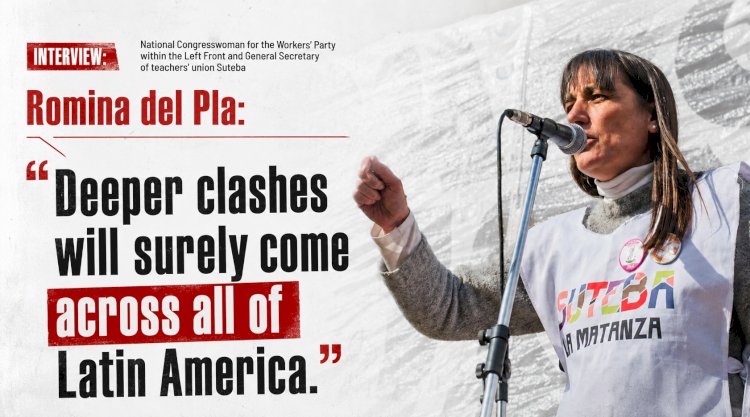
Interview with Romina del Pla, National Congresswoman for the Workers’ Party within the Left Front and General Secretary of Suteba (United Union of Education Workers of the Province of Buenos Aires) for the La Matanza district in Argentina
How did the class-based slate you lead achieve victory in SUTEBA Matanza recently? What significance does this union hold within the Argentine labor movement?
The victory of the Blue and White Multicolor Front in SUTEBA La Matanza—the teachers’ union in one of the most important districts of the province of Buenos Aires—was achieved on the basis of a united front formed by the militant groups that make up the Multicolor [teachers groupings of the PO, the parties of the Left Front – FITU- and independents] and the Blue and White slate, which is part of the PCR (Revolutionary Communist Party), the Maoist current here in Argentina.
The basis of this united front is about regaining control of such an important union to oust the leadership that subordinated teachers’ demands to the [Peronist] provincial government of Axel Kicillof and the national government of Milei. The central slogan was “Let’s get our union back.”
On that note, the elections took place on May 13, and we achieved a massive mobilization of teachers to vote, resulting in 2,297 votes for the Multicolor Azul y Blanca slate and 2,135 for the Celeste [Peronist trade union bureaucracy] slate.
SUTEBA Matanza is of great importance because it has 9,700 members within a district that has around 30,000 teachers—just our district alone—and therefore has a fundamental impact. Furthermore, the provincial SUTEBA, the provincial union, is led by a bureaucrat from La Matanza, María Laura Torre, who won the province but lost her district.
So, it carries significant weight because it has a long tradition of militancy, anti-bureaucracy, and struggle; therefore, it is very important that it return to the hands of sectors of the left.
How do you balance your role as a union leader and national representative for the Workers’ Party and the Left Front?
- We start from the premise that we are union leaders who continue to work in our jobs. I continue to teach a few hours a week as a professor while serving as a national congresswoman, and I continue to do so now that I have taken office as the union’s general secretary, because we operate on the principle that we must know what is really happening in the broader teaching profession.
So, since our premise is total independence from the pro-employer parties and governments, and I’ve already served as general secretary for nine years (and for a significant portion of that time I was also a national congresswoman), it’s been very natural for the teaching community to know that I would be the union’s general secretary while also serving as a congresswoman. They had already experienced this, and they know that I remain part of the district’s teaching community, that I continue to fight for every single demand, and that this also gives me a platform to amplify the demands of the teaching community, even within the National Congress. So there is a strong identification with this role of struggle, and there has been absolutely no prejudice regarding my role as a congresswoman.
What is the current situation regarding economic and social conditions in Argentina? How is the Argentine working class experiencing the daily consequences of Milei’s program of drastic cuts?
- Well, the Argentine working class is going through a very difficult time in terms of living conditions. First of all, because there has been a massive decline in the purchasing power of wages; a large portion of workers with formal wages barely make it above the poverty line, and informal employment stands at around 50%. In this context, as a result of Milei’s austerity policies, layoffs and business closures are on the rise on a daily basis—not only in the public sector due to closures and brutal cuts, but also because he has implemented an economic policy that is causing many companies to go bankrupt as a result of a massive, absolute drop in consumption.
In this regard, teachers are having a very hard time because the austerity measures on public education are very severe. On the one hand, in areas under the national government’s jurisdiction—such as universities—there is a major struggle by faculty and the university community against the cuts. On the other hand, in the realm of education for children and youth, since the educational system is provincialized, the salary situation is very poor and there are conflicts in various provinces.
In the province of Buenos Aires, there is a massive loss of purchasing power, and among teachers, moonlighting is widespread. This means that many teachers not only hold two, three, or even four jobs, but also engage in other activities—many linked to gig economy work and the like—because they cannot make ends meet with a salary that covers the necessities of life.
What is the current state of popular support for Milei? How do you interpret the data indicating that the popularity of Gabriel Solano and Myriam Bregman—who stand out as revolutionary alternatives—is on the rise? In which sectors is this popularity strongest? Can we consider this a step forward for the revolutionary forces?
- Well, popular support for Milei is falling. This is quite noticeable because support for his government has dropped to just over 30%. However, it must be said that in order to govern, he relies on very strong collusion from various factions of the pro-business parties, especially Peronism, which always ends up helping Milei’s government pass laws such as, for example, the labor reform, which has been a very, very negative issue. So, while some Peronist legislators vote against these measures, others have a free hand to give Milei their votes; consequently, there is a very high level of collusion among the Radical Civic Union[UCR], Peronism, and, of course, Mauricio Macri’s party [PRO].
In this sense, the left is strengthening itself in a very important role: we are the ones who have come out to confront and fight against Milei’s measures from the very beginning, and we have tried to rise above all that policy of containment. Hence the importance of militant leaderships like this one—SUTEBA Matanza, which we have just won, and others that are being won—and the efforts of the Plenary of Militant Trade Unionism, which brings them together, and of the independent piquetero movement, which includes the Polo Obrero, to fully develop these processes of struggle.
This, then, represents a major recognition that reinforces the role of the Left and Workers’ Front Unity. Hence, its main leaders—such as Gabriel Solano, Néstor Pitrola, and Myriam Bregman—are gaining increasingly significant recognition. We in the Workers’ Party [PO] understand that it is important to ensure the Left and Workers’ Front functions not only as an electoral alternative, but fundamentally as a key factor in the political struggle against the government of Javier Milei and his accomplices. And that is why we are, well, pushing for a National Assembly of the Left and Workers’ Front and joint committees to bring new sectors of workers into this struggle. And in that sense, we believe this is a very important issue because we cannot think that the left has to play a role solely in view of a future election; on the contrary, we must intervene now, because that is what has given us this authority.
In parallel with the economic austerity packages, the Milei government is aggressively pushing for constitutional reform, the police protocols against protests introduced by Patricia Bullrich, and mechanisms of judicial harassment (lawfare). The criminalization of the piquetero movement and the Polo Obrero is extending to the Partido Obrero, creating a new wave of repression through the judiciary. Could you elaborate on this new wave of judicial destruction, which aims to completely dismantle social gains by cutting them under the pretext of “preventing the exploitation of the poor,” and on the ongoing legal proceedings facing the Workers’ Party? Could you discuss the legal proceedings and repression currently facing the Workers’ Party?
-Javier Milei’s government has taken the policy of repressive and judicial persecution against the sectors that are fighting to an extreme. However, we must remember that this is by no means the first time this has happened; we have had several periods, especially since 2001, of massive criminalization of social protest. Milei’s government, however, has taken a political leap forward in this regard with the anti-picket protocol to persecute those who take to the streets. Nevertheless, this has not prevented the mobilizations as a whole, nor has it prevented the mobilizations from taking over the streets when they are very massive, rendering the anti-picket protocol inapplicable.
We have seen several such episodes: the four university marches, the Women’s Day demonstrations on March 8, and demonstrations on the anniversary of the military coup. More recently, on June 3—the date of the Ni Una Menos campaign against femicides—there were many instances of massive demonstrations that defied the anti-picket protocol. In other words, we must recognize that these measures have failed to curb the protests, although they are, of course, intensifying the levels of persecution.
In that sense, the cases filed against many organizations—but especially against the Polo Obrero, which is of course linked to the persecution of the Partido Obrero—are intended as a warning to those who are the government’s staunchest opponents. So this attempt at prosecution stands in contrast to the corruption cases emerging from Javier Milei’s government, which are becoming increasingly serious: the Libra cryptocurrency scam, which involves Javier Milei and his sister; the case of overpricing at the agency responsible for serving people with disabilities; the case of illicit enrichment involving the chief of staff, Manuel Adorni; and cases at the nuclear power company against Reidel and other officials. Let’s just say these are very notorious cases of corruption that the very same justice system that persecutes organizations fighting for workers’ rights, like the Polo Obrero, chooses to overlook or investigate at a painfully slow pace. In other words, we have this stark contrast of a judicial system clearly at the service of persecuting the people, and well, we are going to defend ourselves and we are going to continue our campaign to expose the true objective of this corrupt government that persecutes workers who fight back.
Latin America finds itself at a very critical and acute historical crossroads. Following Venezuela and Cuba, which are under intense imperialist pressure and embargoes, we see that the workers and indigenous peoples of Bolivia have launched a major insurrectionary movement that has besieged the capital and shaken the ruling power. Just as a new crisis of order is emerging in the global capitalist system, what can be said about the dynamics of mass movements in Latin America, caught between a rising right-wing tide, failed leaders of the Pink Tide, and massive uprisings?
- Well, it is clear that internationally we are experiencing this crisis of the traditional parties—which are the parties of political containment in each country—and that this crisis emerges from the depths of the global crisis and from subjugation to the International Monetary Fund and its policies. We see how variants are appearing that present themselves as extreme on different sides, from the right to the left.
In that sense, what we believe is essential to recognize is that in Argentina we have the possibility of developing a variant that is consistently independent of the state and the regime through the Left Front, because in other countries there is not yet the emergence of forces that are truly fighting for a workers’ government and socialism.
The example of Bolivian workers and peasants who are coming out in force to confront Ramiro Paz’s austerity policies is an example for the entire continent. We believe it is essential that this movement have a depth that goes beyond merely ousting the government. So, from the outset, we are watching this process very closely because we believe that much deeper clashes will surely come across all of Latin America.