

The Cockroach Uprising: An Analysis of India's Youth Rebellion
 Socialist
Jul 28, 2026 07:08
835
Socialist
Jul 28, 2026 07:08
835
By Umar Shahid
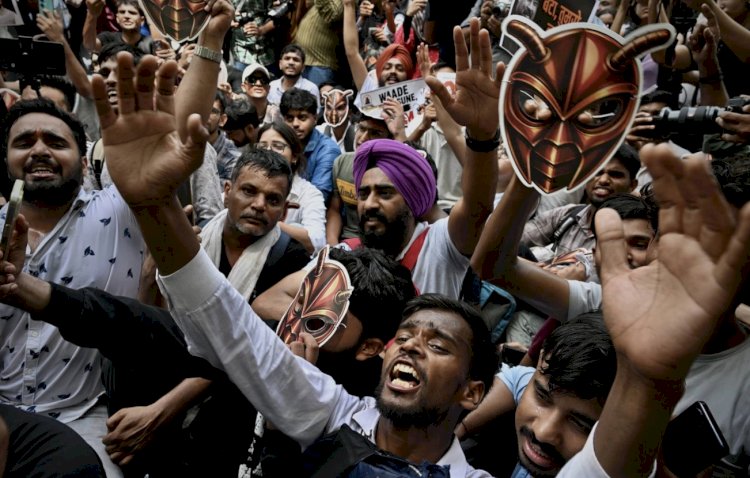
The morning of 20th July brought disturbing scenes from Jantar Mantar Delhi, where tens of thousands of students, parents, retired professors, and professionals had gathered despite heavy rain. The ongoing sit-in (dharna) of the Cockroach Janta Party (CJP) turned into a battlefield between protesters and police. When the protesters attempted their "Sansad Chalo" (March to Parliament) march, the state responded with its full arsenal: tear gas canisters arcing through the air, baton charges that left head wounds and broken bones, welded barricades sealing off access to Parliament House, metro stations shuttered, mobile internet suspended. Police in riot gear entered Jantar Mantar and announced that protesters no longer had permission to remain, pushing people back and dismantling their tents. The police crackdown with tear gas, baton charges, and welded barricades reveals the state's true character. It is the armed committee of the bourgeoisie, tasked with maintaining conditions for capital accumulation. But young people refused to leave the place, and the sit-in again continued.
On 6th June 2026, CJP started a peaceful dharna at Jantar Mantar. Sonam Wangchuk, a social activist and education reformer, also joined the protest and, along with others, started a hunger strike at the dharna. Over a month, CJP peacefully agitated, and Wangchuk's 21-day hunger strike continued. The Indian media completely neglected the news about the dharna or any development. The CJP activists and young people started mobilising through social media. Many leading celebrities also joined the protest and pressurised government for accepting demands of the protestors. Their basic demands were resignation of education minister Dharmendra Pradhan, compensation of 10 million rupees for each suicide victim, abolition of the National Testing Agency, and withdrawal of the National Education Policy 2020.
The bourgeoisie's response has been predictable. Prime Minister Modi's silence speaks volumes. When the leader of the world's largest "democracy" cannot face a press conference for 12 years, when he cannot address the youth directly, we see the decay of bourgeois democracy into naked authoritarianism.
CJP: From Insult to Identity
The CJP began as satire has become the most serious challenge to Prime Minister Narendra Modi’s government in his third term. The movement is already exposing deep fractures in India’s education system, soaring youth unemployment, and the erosion of instructional accountability. The CJP was born from an unlikely provocation. In May 2026, India’s Supreme Court Chief Justice Surya Kant, during a court hearing, compared unemployed young people to “cockroaches” and “parasites” who attack the system when they have “no place in profession”. Although later he claimed that his remarks were misunderstood, the real damage was done. Abhijeet Dipke, a 30-year-old Dalit with a master’s degree in public relations from Boston University, seized on the insult. He launched a satirical online post: “What if all cockroaches come together?”. Within 24 hours, over 30,000 people had signed up. Today, its Instagram following has eclipsed 23 million, more than double the BJP’s.
Despite its humorous origins, the CJP quickly became a lightning rod for disaffected young people in India, where there is high youth unemployment. The birth of CJP was not merely an accident, but it is organic expression of a generation that has been systematically betrayed by the Indian state’s comprador bourgeoisie, and mainly bankruptcy of Indian communist parties gave vacuum to rise this alternative movement. It is also revealed the ruling class’s deepest fear that the dispossessed will recognize their collective power.
NEET - The Spark for movement
The immediate trigger for the movement, ‘NEET examination paper leak,’ proved to be merely the spark. This spark worked as a catalyst to bring decades of neoliberal restructuring, youth deprivation and exploitation over the surface. National Eligibility Cum Entrance Test (NEET) is an important milestone in any Indian student life. As after ‘All India Senior School Certificate Examination’ (12th-grade exam) through the CBSE board, NEET passing is a must for admission in medical universities. In countries like India, Doctor, Engineer, IT are considered highly paid and respected professions. It is also the wish of any parent that their kid get admission into a prestigious medical university. But due to scarcity of resources and limited admission opportunities, NEET has become a billion-rupee business. The 2.28 million students who sit for medical entrance examinations are not seeking individual advancement alone; they represent the aspirations of a petty bourgeoisie that the Indian state has promised mobility but delivered only precarity. So, coaching centres, leaked examination papers, cheating, fraud, and manipulation to get high grades in NEET is often carried out by rich and powerful people. NEET encountered controversy in 2024 following reports of paper leaks from various states. After several candidates received abnormally high scores, many parents and students questioned the results.
In 2026, the NEET issue became more serious as the Supreme Court intervened, and instead of a fair investigation, the government announced the cancellation of the examination. It led to frustration among many poor and bright students, who were unable to pay high fees to coaching centres again. Following the leak, between 12 and 20 young people have committed suicide, and these are not individual tragedies; they are social murders. Each death is an indictment of a system that values profit over human life, that reduces young people to units of human capital to be discarded when they fail to yield surplus value.
Youth Unemployment: The Structural Crisis
The current movement’s broader appeal stems from a deeper crisis that India is failing to create jobs for its youth which is also the largest cohort in the world’s most populous nation. According to the Indian Ministry of Statistics and Programme Implementation’s Periodic Labour Force Survey (PLFS) report of May 2025, ‘Overall unemployment rose to 5.6% from 5.1% in April. Youth unemployment (15-29 years) reached 13.7% in rural areas and 17.9% in urban centres and its annual data report of 2025 states, ‘Youth unemployment improved slightly to 9.9% from 10.3% in 2024, but this still masks severe graduate underemployment’. Only 23.6% of Indian workers are in regular wage or salaried employment. The remainder exist in the informal sector, precarious, unregulated, and without social security. This is not a labor market; it is a system of super-exploitation.
Economist Rosa Abraham of Azim Premji University points to a more alarming figure, ‘around 40% of university graduates under age 25 are unemployed—among the highest rates in decades. Even when graduates find work, entry-level salaries have declined in real terms compared to a decade ago. Many are forced into casual labor in agriculture or construction, where income is precarious. Political scientist Bhanu Joshi notes that successive governments have addressed unemployment primarily through welfare benefits rather than structural job creation. “It’s like saying, unemployment is a huge issue, but I cannot solve it. Let me give you 1,500 rupees and take care of your grievance”.
Already in a report, Abraham warns: “We are sitting with a generation of the most educated group of youngsters we’ve ever had in the country. If they are not given the means to utilize this education, that’s going to lead to frustration, which can come out in different forms of unrest”.
The Modi’s economic policies have been serving to the narrow interests of monopoly capital and the privileged upper-caste minority, while dressing itself in the garb of welfare for the masses. The statistics are damning by 2023, the top 1% of the population controlled 40.1% of the nation's wealth and captured 22.6% of the national income—levels of inequality unmatched since the colonial era and among the highest in the world. This is the logical outcome of a regime that has slashed corporate taxes for the ultra-rich, written off massive loans for billionaires like Adani and Ambani, and reduced capital gains taxes for the wealthy, while the real incomes of the peasantry and the working class have stagnated or declined. The state showers subsidies on big business, yet when it comes to the basic needs of the people education, healthcare, and employment, it is perpetually "underfunded," with a paltry $24 billion allocated for job creation over five years, a figure that is an insult to the 12 million young people entering the labour market each year.