

The Anatomy of a Planned Catastrophe: War on Iran - Nida Kaveh
 Socialist
Mar 12, 2026 07:25
1243
Socialist
Mar 12, 2026 07:25
1243
Late Imperialism and the Political Economy of the 2026 War on Iran
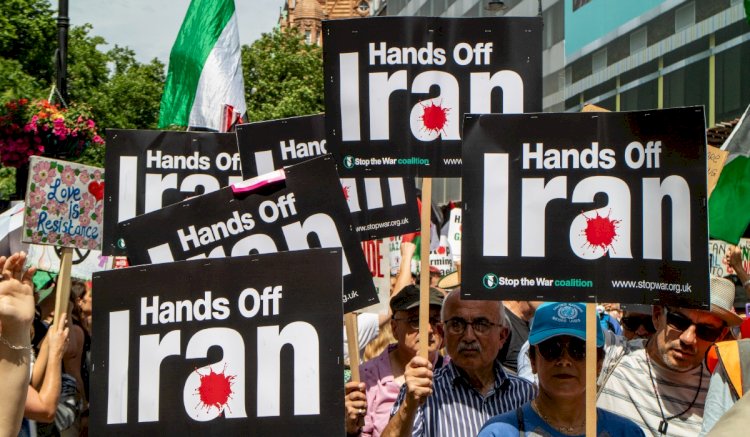
The February 2026 assault on the Iranian plateau, resulting in the destruction of over 5,000 strategic nodes and the deaths of 1,500 individuals, has been widely mischaracterized by the bourgeois press as a localized geopolitical conflict over maritime security. This paper, employing a historical materialist framework, posits that the conflict is not an aberration but a structural necessity of late capitalism. Facing a severe crisis of overaccumulation during the 2020–2030 Crisis Decade, Western financial hegemony required a violent "Spatial Fix." By unpacking the Tendency of the Rate of Profit to Fall, this article dissects the militarization of the Strait of Hormuz, the deployment of autonomous kill-chains as the zenith of alienated labor, and the defense of the Petrodollar as an act of global rent extraction.
I. Introduction: Piercing the Fog of "Security"
To understand the rain of fire that descended upon Iran, we must first discard the ideological illusions spun by the ruling class. The state apparatus and its stenographers in the bourgeois press frame this slaughter as a regrettable necessity to preserve "freedom of navigation" or "regional stability."
This is the classic mystification of capital. The "freedom" they speak of is merely the freedom of capital to circulate unhindered. The 2026 war is the violent resolution of an internal contradiction within global capitalism. It is the bloody, inevitable mechanism by which a stagnant imperial core attempts to resuscitate its dying rate of profit through the mass destruction of infrastructure and human life in the periphery.
II. The General Law of Capitalist Accumulation and the "2030 Cycle"
We cannot comprehend the destruction of 2026 without understanding the agonizing stagnation of the 2020s. Following the supply-chain collapses of the early decade, the Western metropoles found themselves suffocating under the weight of their own productivity. Capital had over accumulated; there were vast oceans of wealth with nowhere profitable to be invested.
The Tendency of the Rate of Profit to Fall (TRPF)
The driving force behind this imperialist aggression is the inevitable decline in the rate of profit. In Capital Vol. III, Marx identifies the Organic Composition of Capital as the ratio between constant capital (c)—machinery, raw materials, and technology—and variable capital (v)—the wages paid to living labor.
As capitalists compete, they are forced to automate, increasing c relative to v. Because only living labor (v) produces surplus value (s), the total rate of profit across the economy is dragged downward. By 2026, the Western economy reached a "technological ceiling" where the massive investments in AI and robotics (dead labor) were yielding diminishing returns. The system was choking on its own efficiency.
War as Devaluation and the "Spatial Fix"
David Harvey’s concept of the Spatial Fix explains how capitalism survives its internal crises by geographically expanding and violently devaluing assets elsewhere. The 2026 war served as a "vent" for over accumulated capital. By 2026, the United States military budget had reached a grotesque $950 billion. This sum represents a mountain of "dead labor" frozen in the form of hypersonic missiles and autonomous drones. Under the laws of capitalism, a commodity must be consumed to realize its value. The military-industrial complex cannot simply stockpile ordnance forever; it requires periodic bloodletting to clear its inventories. The 5,000 targets obliterated in Iran were not merely military assets; they served as the anvil upon which over accumulated Western capital was smashed, clearing the ledger for a new cycle of lucrative defense contracts and reconstruction loans.
III. Technocratic Alienation: The Mass Deployment of "Autonomous Kill-Chains"
The 2026 war marked a qualitative shift: the transition from mechanized warfare to algorithmic warfare. The deployment of Autonomous Kill-Chains represents the absolute, final alienation of labor.
The General Intellect Captured
In his Grundrisse, Marx wrote of the General Intellect—the social knowledge of humanity becoming a direct force of production. In 2026, we see the General Intellect weaponized. The "Kill-Chain" is an automated loop of surveillance, target identification, and execution. The Eradication of Domestic Dissent: By removing the proletarian soldier from the line of fire, the imperial state eliminates "friendly casualties." Without body bags returning to the imperial core, the political cost of perpetual war drops to zero, neutralizing anti-war solidarity.
Data as Primitive Accumulation
The deaths of 1,200 Iranians were instantly commodified. Strike data was fed back into defense contractor servers to train the next generation of targeting algorithms. The periphery is treated as a laboratory where human suffering is the raw material for technological refinement.
The soldier is no longer a "warrior" but a passive monitor—an appendage to a global algorithm that calculates "acceptable collateral damage" with the cold indifference of an accounting ledger.
IV. The Energy Bottleneck: Imperial Rent and the Petrodollar
The strategic focus on the Strait of Hormuz must be viewed as an act of Enclosure of the Global Commons.
The Petrodollar and Parasitic Hegemony
American hegemony relies on the dollar’s status as the global reserve currency, enforced by its ability to trade oil. This allows the US to run perpetual deficits, effectively exporting its inflation to the Global South. When Iran threatened to bypass the dollar or disrupt the flow of oil, it threatened the very foundation of this parasitic financial architecture.
The Regressive Tax of War
The subsequent spike in oil prices to $126 per barrel was not a "market failure." It was a highly successful, engineered transfer of wealth. High energy prices function as a regressive tax on the global proletariat. Every worker in Johannesburg or London paying more to heat their home is having their wages siphoned directly into the vaults of energy conglomerates. The imperial state effectively acts as a global landlord, using Tomahawk missiles to collect a "security rent."
V. The Sub-Imperial Gendarme and the Ideological Apparatus
In the framework of late imperialism, the Zionist entity functions as a sub-imperial relay—a heavily subsidized military outpost designed to discipline the Middle Eastern periphery on behalf of Western capital. To mask this, the media manages an "Economy of Empathy."
"The ideas of the ruling class are in every epoch the ruling ideas." — The German Ideology
The deaths of a dozen soldiers from the imperial core are draped in tragedy to manufacture consent. Conversely, the 1,200 Iranians are reduced to sterile statistics. The hyper-focus on "democratic debates" in Washington creates a façade of choice, obscuring the iron logic: capital must expand, or it will perish.
VI. Conclusion: The Missile as the Messenger of the Market
Late Imperialism has built a permanent war economy that requires regular, catastrophic blood sacrifices to forestall its own structural collapse. The task of the international proletariat is not to beg for "peace" at the tables of bourgeois institutions. Peace within capitalism is merely the breathing room between wars.
The only way to break the 2030 cycle of violence is to seize the means of production—and permanently dismantle the means of destruction. As long as the Market remains the master, the Missile will be its messenger.
VII. Forecast: The Expropriation of the Expropriators
What, then, is the inevitable historical trajectory of this decaying epoch? The pyre lit upon the Iranian plateau will not be confined to the periphery; its flames must inevitably lick the foundations of the imperial metropoles themselves. As the bourgeoisie increasingly relies upon the automated slaughter of "dead labor" to enforce its parasitic extraction, it only accelerates the concentration of capital and the profound immiseration of the global masses.
The temporary economic relief bought by the blood of the colonized will soon evaporate, giving way to an even more paralyzing crisis of overaccumulation. The ruling classes tremble at the prospect of a generalized global conflagration, yet the iron laws of their own system blindly drive them toward it. But the very autonomous weapons forged for imperialist subjugation simultaneously forge the conditions for the system's own negation. Driven by the sheer material reality of economic ruin, climate collapse, and endless war, the international proletariat must inevitably cast off its manufactured nationalist illusions. The impending cycle points not merely to the collapse of the petrodollar, but to the necessary transformation of imperialist war into class war. The expropriators will be expropriated. Let the ruling classes tremble at a communist revolution. The proletarians have nothing to lose but their chains. They have a world to win.